Space Cat Vector Illustration
A Designer’s First Glance: Playful, Not Precious
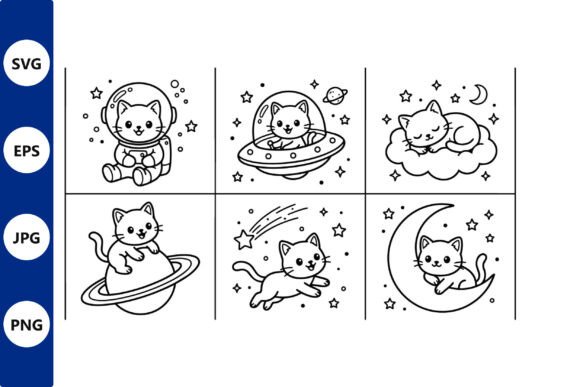
Opening Space Cat Vector Illustration feels like flipping to a favorite page in a well-loved children’s book—whimsical but grounded, detailed but never fussy. The composition balances three clear focal points: a cat astronaut (helmets and all), a flying saucer with a grinning feline pilot, and a sleepy cat curled on a cloud beneath a crescent moon and scattered stars. It’s not just “space-themed”—it’s *story*-themed. That matters when you’re stitching for real people who’ll hold, wear, or gift the finished product.
Where This Design Lives Best—And Why
I recently tested Space Cat Vector Illustration as a central motif on a medium-weight organic cotton tote bag for a local boutique’s summer launch. It worked beautifully—not because it’s “easy,” but because its bold outlines and intentional negative space translate cleanly into stitch. The flying saucer’s smooth curves held up under satin stitch, the crescent moon read clearly at 3.5 inches wide, and the star cluster added charm without overwhelming the hoop. This isn’t a design for subtle monograms or minimalist branding. It’s for custom apparel that sparks joy: baby onesies with a single sleeping cat, embroidered patches for scout troops, pillow covers for nurseries, or holiday tea towels where whimsy meets warmth.
Real Embroidery Behavior: What Holds Up, What Needs Care
In machine embroidery, clarity beats complexity—and Space Cat Vector Illustration leans into clarity. Its vector foundation means clean edges and scalable lines, which is essential when converting to an embroidery file. But vector doesn’t equal automatic stitch success. Here’s what I watched closely:
- Stitch density: The cloud and saucer fill areas are generous but not overly dense—ideal for sweatshirt embroidery where heavy fills can stiffen fabric. On lightweight linen tea towels? I reduced fill density by 15% and added a light tear-away stabilizer underneath.
- Small details: The cat astronaut’s visor reflection and tiny planet outlines are charming—but they shrink fast. Below 2.75 inches wide, those elements risk becoming muddy. For caps or baby hats, I’d simplify or omit them entirely rather than force legibility.
- Fabric texture & stretch: On ribbed knit sweatshirts, I used cut-away + topping to keep stars crisp. On stretchy jersey onesies? I avoided the outer star cluster altogether—too many small isolated elements on unstable fabric invite puckering.
- Dark vs. light backgrounds: Tested on navy denim and ivory canvas—thread contrast made all the difference. On dark fabric, white or metallic silver thread lifted the moon and stars; on light, navy or charcoal brought depth to the cats’ outlines. Always test thread colors before committing to a full run.
Commercial Use Realities: Trust, Value, and Repeat Buyers
As an Etsy seller and small shop product developer, I pay attention to how designs shape customer perception. Space Cat Vector Illustration reads as handmade—not mass-produced—because of its expressive shapes and gentle asymmetry. That builds trust. When buyers see this on a personalized gift (say, a toddler’s first birthday apron with their name stitched below), it feels considered, not generic. It also scales well across product types: same core file works for a 4-inch embroidered patch, a 6-inch tote bag design, or a layered nursery wall hanging—just adjust hoop size and stabilizer strategy accordingly.
That said, don’t assume it fits every commercial embroidery scenario. It’s not ideal for ultra-fine detail work like wedding handkerchiefs or delicate lace overlays. And while it’s perfect for playful holiday embroidery (think Halloween trick-or-treat bags or cosmic Christmas stockings), avoid pairing it with formal branding—it won’t reinforce a luxury skincare line or corporate teamwear.
Practical Designer Notes Before You Stitch
Before turning Space Cat Vector Illustration into a finished product—whether for your own craft business or a client’s custom apparel—do these five things:
- Run a test on scrap fabric matching your final product’s weight and weave. Watch how stars hold shape and whether the cloud’s edge stays soft or turns jagged.
- Check licensing. Since this is listed as a Graphics product in the Illustrations category, confirm whether commercial use (e.g., selling embroidered totes on Etsy) is permitted—and whether resale of the digital embroidery file itself is allowed.
- Review stitch order in your embroidery software. Rearrange so large fills (like the saucer body) go down before fine details (like star dots) to minimize thread breaks and re-hooping.
- Simulate in black-and-white mockups. If the composition loses hierarchy or balance without color, simplify before digitizing.
- Verify hoop size compatibility. At full scale, this illustration likely needs at least a 5x7 hoop. For smaller applications (caps, patches), isolate one element—like the sleeping cat—rather than shrinking the whole scene.
Final Thought: A Design That Earns Its Place
Space Cat Vector Illustration isn’t flashy—but it’s reliable. It doesn’t shout. It invites. That’s rare in digital embroidery assets today. When stitched thoughtfully—with attention to fabric, stabilizer, thread, and scale—it becomes more than decoration. It becomes a reason someone chooses your handmade product over another’s. A reason they tag you on Instagram. A reason they come back for the next season’s design. In the end, that’s what makes a vector illustration truly useful: not how many planets it includes, but how well it helps you make something real, meaningful, and unmistakably yours.